ATT&CK-mapped emulation
Run initial access, execution, persistence, privilege escalation, and exfiltration techniques tied to documented adversary behavior.
Work with ethical security specialists who translate urgent searches into authorized, documented cyber defense. The scope covers collaborative offensive testing, blue-team tuning, detection engineering, playbook improvement, and analyst training.

Purple teaming is not a contest between attackers and defenders. It is a collaborative exercise where offensive operators run known techniques while your defenders watch the telemetry in real time, so every gap becomes a tuned alert, a new log source, or a sharper playbook before the exercise ends.
We map the work to MITRE ATT&CK, run techniques your real adversaries use, and sit with your blue team to confirm what was logged, what alerted, what was missed, and what the analyst actually saw. The deliverable is improved detection coverage, not a list of things you failed to catch.
A red team tells you that you were beaten. A purple team makes sure you can see it next time. By pairing each emulated technique with live defender feedback, the exercise produces concrete detection rules, log-source fixes, and playbook updates you can verify on the spot.
Run initial access, execution, persistence, privilege escalation, and exfiltration techniques tied to documented adversary behavior.
Confirm in real time which techniques were logged, which alerted, and which slipped past unnoticed.
Write and tune the alerts, correlation rules, and log sources needed to close each blind spot found.
Update triage and response runbooks so analysts act faster and more consistently on the next real event.
Defenders learn attacker tradecraft directly, improving how they hunt and investigate afterwards.
A before-and-after view of detection coverage across the techniques exercised, with the gaps that remain.
Every test runs inside written rules of engagement against assets the client owns or has documented authority to assess. We do not test third-party systems without permission, exfiltrate data outside the agreed scope, or leave any technique in place beyond the engagement window.
| Decision Point | Ethical Service | Unsafe Shortcut |
|---|---|---|
| Access | Written permission and scoped assets. | Secret access, stolen credentials, or unclear ownership. |
| Method | Documented testing, investigation, and evidence handling. | Vague promises with no defensible method. |
| Output | Report, evidence, risk rating, remediation, and retest path. | Screenshots or claims that cannot be verified. |
| Risk | Designed for compliance, recovery, and business action. | Legal, payment, platform, and reputation risk. |
What the work produces matters more than how it sounds. Expect ranked findings, reproducible evidence, owners, dates, and a closure record — not a glossy PDF and a hope that the right thing happens next.
collaborative offensive testing, blue-team tuning, detection engineering, playbook improvement, and analyst training
Exercise plan, ATT&CK mapping, detection updates, playbook changes, training notes, and coverage report.
Every test runs inside written rules of engagement against assets the client owns or has documented authority to assess. We do not test third-party systems without permission, exfiltrate data outside the agreed scope, or leave any technique in place beyond the engagement window.
Purple Teaming fits clients who can prove ownership or authority and need decisions about collaborative offensive testing, blue-team tuning, or detection engineering.
Purple Teaming timing depends on evidence quality, access approval, stakeholder availability, asset count, and the depth of validation required.
Purple Teaming pricing changes with urgency, records to review, systems in scope, reporting depth, retesting, and the level of stakeholder support.
The exercise is collaborative and iterative rather than a single graded test.
Select ATT&CK techniques relevant to your threat model, environment, and detection priorities.
Run each technique while the blue team observes telemetry and notes what they can and cannot see.
Build or adjust detections, add log sources, and re-run techniques to confirm the new coverage fires.
Document validated detections, remaining gaps, playbook updates, and a roadmap for the next round.
Purple teaming only works when both sides collaborate and detections actually change. These checks confirm that.
The point is to improve coverage during the exercise, not just report what was missed afterwards.
Techniques should map to documented adversary behavior, not a generic toolkit run for show.
Your blue team should be in the room learning, not handed a PDF after the fact.
Success is a before-and-after detection-coverage story, not a count of techniques executed.
Work through the points below before signing a scope: what is being reviewed, what counts as evidence, what the work refuses, and what the deliverable proves.
The exercise is judged by how many techniques you can now see, not how many were run. Each emulated behavior should end as a working alert, an added log source, or a documented decision to accept the gap, all verifiable before the team leaves.
Because attackers and defenders work together, a missed technique is not a failure to hide; it is a coverage gap to close on the spot. That openness is what makes purple teaming produce durable improvement instead of a scorecard.
Technique selection should reflect your real adversaries and architecture, identity abuse for a SaaS company, ransomware precursors for an enterprise, rather than a generic checklist run for appearances.
A rule that only fired in a lab helps no one. Tuning accounts for noise, false positives, and maintainability so the new coverage still works under real production traffic weeks later.
Buyers reach this page for very different reasons. Each path below points to the safe service shape for that situation.
Validate and improve detection coverage against real techniques while building analyst tradecraft.
Turn observed gaps directly into tuned rules, correlation logic, and new log sources.
Get a measurable before-and-after coverage story to justify tooling and staffing decisions.
Convert a red team's findings into concrete detections instead of a list of things that were missed.
A serious Purple Teaming engagement should produce service-specific proof, not generic cybersecurity theater. The evidence should connect collaborative offensive testing, blue-team tuning, detection engineering, playbook improvement, and analyst training to a clear decision, accountable owners, and practical remediation.


Pricing for Purple Teaming depends on the assets in scope, access quality, urgency, reporting depth, stakeholder support, and whether validation or recurring review is needed.
| Engagement Size | Typical Fit | What Changes the Scope |
|---|---|---|
| Purple Teaming triage | A narrow question around collaborative offensive testing or suspicious activity. | Evidence quality, access availability, urgency, and the number of records to review. |
| Focused Purple Teaming | A defined engagement covering collaborative offensive testing, blue-team tuning, and a specific deliverable. | Asset count, approval speed, test window, stakeholder review, and validation depth. |
| Program-level Purple Teaming | Recurring or multi-team work where Purple Teaming affects governance, monitoring, compliance, or several business systems. | Reporting cadence, control mapping, owner coordination, retesting, and executive support. |
Bring the items below to the first call and the engagement starts faster, cleaner, and at the right price.
Before purple teaming begins, define the exact business question, the assets or accounts in scope, the owner who can approve access, and the deadline behind the request. Keep the intake tied to collaborative offensive testing, blue-team tuning, detection engineering, playbook improvement, and analyst training so the work begins with the buyer's real situation.
Collect only evidence that supports this specific engagement: system lists, alerts, screenshots, logs, URLs, configuration notes, policy records, or ownership proof tied to purple teaming. The goal is to prove the issue without spreading unrelated sensitive data.
Name the teams that can provide access, approve changes, receive findings, and close remediation. For purple teaming, ownership should map directly to the expected outputs: exercise plan, att&ck mapping, detection updates, playbook changes, training notes, and coverage report..
A useful purple teaming report should show what was reviewed, what was found, why it matters, what evidence supports it, who owns the fix, and how success will be validated. That makes the report useful to decision-makers and technical owners.
Be careful with providers who cannot explain how purple teaming will be scoped, what evidence they need, what they refuse, or how the final deliverables will help your team act. Vague promises are a poor substitute for a defensible method.
After delivery, assign owners, address the highest-risk findings, document accepted risk, update controls, schedule validation, and keep a clean record of exercise plan, att&ck mapping, detection updates, playbook changes, training notes, and coverage report. for leadership, compliance, or follow-up work.
Define the risk question around collaborative offensive testing before work starts, then compare findings, fixes, validation notes, and residual risk after delivery.
Every issue should map to an accountable team, suggested priority, evidence, and validation step for blue-team tuning.
Not every issue can be closed immediately. The report should separate urgent fixes, accepted risk, compensating controls, and backlog work.
Validation should prove the important fixes worked, update evidence, and leave a closeout record the client can reuse.
Run these checks before sharing anything sensitive. A provider who cannot answer them is not the one to trust with this work.
Know which assets, accounts, workflows, or controls should be reviewed and who can approve access. A focused purple teaming request is easier to quote, easier to deliver, and more useful than a broad request for general cyber help.
Searchers often use rough wording when they mean legitimate help. This page keeps the conversation on collaborative offensive testing, blue-team tuning, detection engineering, playbook improvement, and analyst training, written authorization, evidence, and remediation. It does not convert aggressive search language into unauthorized access or platform bypass promises.
Good examples should match the service. For purple teaming, useful proof may include scope notes, affected systems, screenshots, logs, control evidence, owner assignments, risk ratings, remediation records, and validation steps.
Look for providers who can walk through their method end to end, name what they refuse, show a redacted sample deliverable, and explain how they handle sensitive evidence. Polish without those details usually signals marketing, not capability.
Arrive with documented ownership, the people who can approve access, a short business context, any prior reports or alerts, the deadline driving the work, and the decision the engagement is meant to support.
Purple Teaming can lead into related work such as incident response, penetration testing, cloud security, code review, monitoring, or compliance support. The related path should follow the evidence, not a generic service menu.
Every finding should connect to affected assets, observable evidence, realistic impact, a fix path, and a validation method. Unsupported claims should not drive purple teaming.
The work is not finished when a PDF lands. The client should assign owners, fix priority issues, document accepted risk, update monitoring or controls, and schedule validation that matches the original scope.
A common credential-access technique produced no alert; a tuned rule and a new log source caught it on the re-run.
Remote-service abuse went unseen until the team built a correlation rule that fired on the second pass.
Analysts rewrote a triage runbook mid-exercise, turning a confused investigation into a clear, repeatable response.
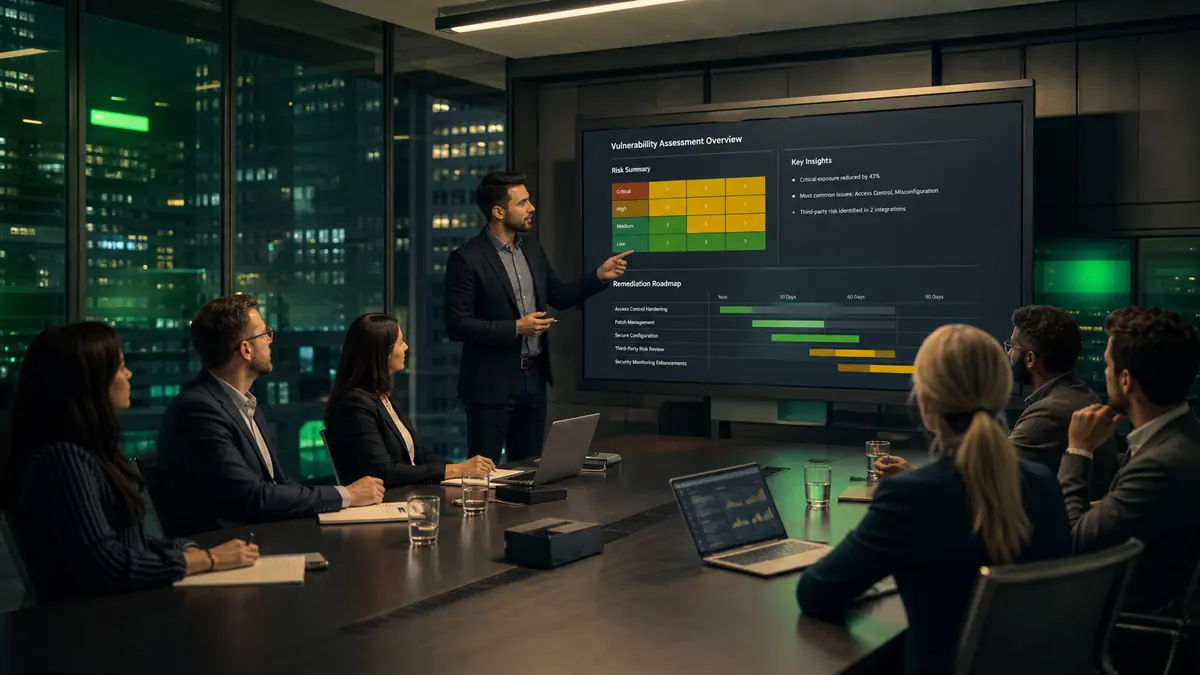
Exercise plan, ATT&CK mapping, detection updates, playbook changes, training notes, and coverage report.
Reviewed for authorization, collaborative offensive testing, evidence quality, and whether the final deliverable supports a real security decision.
Frameworks are selected when they help this scope, especially for collaborative offensive testing, blue-team tuning, audit evidence, incident handling, or platform policy.
Timing depends on evidence access, approval speed, asset count, stakeholder availability, and how much validation the Purple Teaming deliverable requires.
Purple teaming is a collaborative exercise where offensive operators run known attack techniques while your defenders watch the telemetry, so every gap becomes a tuned detection, a new log source, or an improved playbook during the engagement.
A red team works covertly to test whether you get caught. A purple team works openly with your defenders to improve detection and response in real time. Red team measures the outcome; purple team builds the capability.
Yes. Techniques are selected and documented against ATT&CK so coverage gains are measurable and tied to documented adversary behavior, not a generic toolkit run.
Yes, that is the point. Defenders observe each technique, confirm what was logged and alerted, and tune detections on the spot, learning attacker tradecraft directly.
A coverage report showing which techniques were detected before and after tuning, the detections and log sources added, playbook updates, and a roadmap for the next round.
Written authorization, a threat model or technique priorities, access to the environment in scope, and your defenders available to participate during the exercise.
A focused exercise commonly runs from several days to a few weeks depending on the technique set, environment, and how much detection engineering is done during the engagement.
Yes. Engagements can be covered by NDA, use least-privilege access, and limit retained evidence to what delivery and remediation require.
Send the collaborative offensive testing details, ownership proof, urgency, and the decision you need. We will confirm the allowed path before technical work begins.